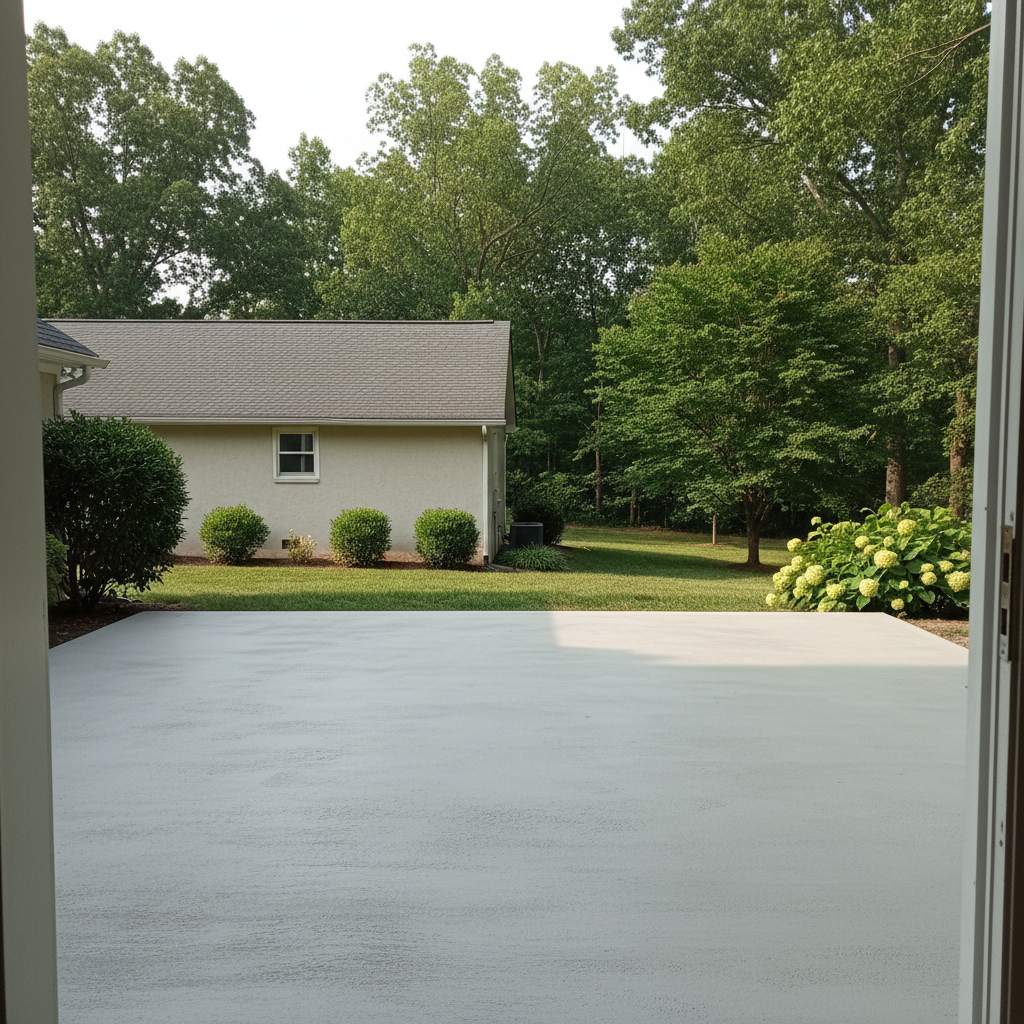
Concrete work looks simple from the street. A truck shows up, somebody screeds it flat, a few days later it's hard. What you can't see from the sidewalk is the part that decides whether that slab is still flat in ten years or heaving at the joints by year three. In Waldorf that part matters more than most places, because of what's underneath your yard.
This isn't written around any one job. Whether it's a driveway, a patio, a set of porch steps, or a retaining wall holding back a sloped lot, the same questions apply and the same corners get cut by the same kind of contractor.
The ground under Waldorf is the first thing to understand
Charles County sits on Coastal Plain soil, and a lot of it is clay or clay loam that holds water. Clay swells when it's wet and shrinks when it dries out, and a slab poured on top of that movement without the right base and the right drainage will eventually show it. Low-lying lots near the Mattawoman Creek drainage or the Zekiah Swamp side of the county can also sit close to a high water table, which means a footing or a slab foundation needs to be dug and compacted correctly or it settles unevenly.
A contractor who knows the area will compact a gravel base, usually 4 to 6 inches, before any concrete goes down, and will grade the surface so water moves away from the house instead of pooling against the slab. If someone quotes you a driveway or patio without ever mentioning the base, that's worth asking about directly.
Licensing, insurance, and what the paperwork actually proves
Maryland requires a Maryland Home Improvement Commission license for most residential work, and concrete falls under that for driveways, patios, walks, and similar jobs. Ask for the license number and look it up yourself rather than taking a business card's word for it. Ask for proof of general liability insurance too. If a form crew gets hurt on your property and the contractor has no coverage, that liability can land on you as the homeowner.
A contractor who hesitates when you ask for this, or gets vague about which name the license is under, is telling you something. Walk away from that one before you walk away from anything else on this list.
What a real quote should talk about
A lot of homeowners compare bids on price per square foot and stop there. That number means very little without knowing what's in it.
- Thickness and reinforcement. A standard residential driveway slab is usually 4 inches thick, sometimes 5 or 6 for a spot that'll see heavier vehicles. Ask whether it's reinforced with wire mesh or rebar, and know that mesh only works if it's actually held up in the middle of the pour, not left sitting on the ground where it does nothing.
- PSI strength. Residential concrete is commonly 3,000 to 4,000 PSI. Driveways and anything that'll take vehicle weight should be on the higher end of that range.
- Control joints. Concrete cracks. That's not a defect, it's physics, and the only question is whether it cracks where you want it to. Joints should be cut within the first 24 hours after the pour, at roughly 8 to 10 foot intervals for a typical slab, before the concrete decides on its own where to split.
- Cure and traffic timeline. You can usually walk on fresh concrete after 24 to 48 hours. Driving on it should wait at least 7 days. Full strength takes about 28 days, which matters if you're planning to park something heavy on a new driveway right away.
None of this needs to be hidden in fine print. A contractor who's done the work explains it without being asked twice.
What should make you walk away
A couple of specific things come up often enough in this trade to call out by name.
A quote that's dramatically lower than everyone else's is usually lower because something's been left out, most often the base prep or the reinforcement. You won't see the difference on pour day. You'll see it in two winters when freeze-thaw cycling, which Southern Maryland gets maybe 15 to 25 times a season, starts working on water that got into a crack it shouldn't have.
A contractor who wants full payment up front, before any material is on site, is a red flag in any trade, not just concrete. A deposit is normal. The full balance before the job starts is not.
Watch for anyone who won't give you a written contract with a start date, a scope of work, and the mix specs in it. Verbal agreements are hard to hold anyone to once the truck's already poured.
Permits, inspections, and Waldorf's older streets versus the newer ones
Charles County handles permitting for most structural concrete work, and larger jobs like a slab foundation, a retaining wall over about 4 feet, or anything that changes drainage on the lot typically need a permit and an inspection before and after the pour. Simple flatwork like a small patio or a sidewalk replacement often doesn't, but it's worth a phone call to confirm rather than assuming either way. A good contractor pulls the permit themselves and knows which inspections apply to which job, rather than leaving you to figure it out.
Waldorf is mostly the planned community of St. Charles, built out in sections from the 1960s through the 2000s, so a lot of the area has an HOA with its own rules about driveway materials, fence lines, and sometimes even the color of stamped concrete. If you're in Pinefield, Fairway Village, Smallwood, or one of the other St. Charles villages, check your HOA guidelines before you pick a finish. Older sections closer to Old Waldorf or the Route 301 corridor were built with less of that oversight, but those lots sometimes have older utility lines or septic fields closer to the surface than a newer subdivision would, which matters when you're digging footings for steps or a retaining wall.
A plain gut check
Before you sign anything, ask to see a job the contractor finished at least a year or two ago, not last month. Fresh concrete looks good for everybody. What you want to see is how it held up through a summer of heat and a winter of freeze-thaw. Ask who'll actually be on site pouring and finishing it, since a lot of outfits sub that part out. And ask what happens if it cracks somewhere it shouldn't in the first year. A contractor who's confident in their mix and their base prep will answer that without getting defensive.
We've laid plenty of driveways, patios, and foundations on this clay, in this heat, through this same freeze-thaw cycle every winter, and that's the kind of thing worth asking any contractor about before you hire one. If you want to see how we handle it, our concrete contractor work is a reasonable place to start comparing against whatever else you're looking at.